VDP. Große Lagen®

ROSENGARTEN
In the western part of the town of Rüdesheim lies the oldest castle complex in the Middle Rhine Valley – Brömserburg. The fortress was built around 1044 AD and is considered one of the earliest settlement sites in the town’s history.
The overall ROSENGARTEN site is divided into three main vineyards, separated from one another by historic quartzite walls. It represents a combination of three individual clos, each with its own distinctive terroir.
Within the ROSENGARTEN site, we distinguish between Rosengarten, located in the eastern main section; Kreuzgarten, situated north of Brömserburg; and Bienengarten, which borders to the west.
The soils here are primarily characterized by alluvial deposits, deep and calcareous loess, as well as a slight quartzite influence, offering good water retention and drainage capacity.
Wines from the Rosengarten site impress with delicate fruit and a persistent, generous depth.
%20(11).jpg)
BERG ROTTLAND
The vineyard, which begins on the western edge of Rüdesheim, is ideally south-facing and has an average slope of 33%. The soils here consist of slate rubble. In color, they are dominated by the gray tones of weathered, gray-blue Hunsrück slate, a marine clay slate.
The dark brown, humus-rich topsoil is usually covered with slate slabs and fine slate fragments. The cavities between the loose stones are well aerated, ensuring excellent air circulation within the soil.
The stone cover protects the soil from drying out and erosion. The soil contains a high proportion of clay-rich, mineral-laden fine earth derived from the weathering of clay slate. In addition, loess is intermixed.
The supply of minerals is excellent, as the clay-based substrate is rich in potassium, magnesium, sodium, and iron. The easily weathered clay slate provides ample nutrients and trace elements. It is here that the grapes ripen earliest.

BERG ROSENECK
Within the BERG ROSENECK site, rocky outcrops of granite rise from the vineyard, overgrown with wild roses, rosehips, and sloes — which is why the individual vineyard was originally known as “Rosenhecke” (rose hedge).
The first vineyards were planted here around the year 1200. At that time, they climbed the hillside in numerous small terraces. Around 1700, the first reinforced pathways were constructed, supported by dry stone walls built into the slope.
The slate and quartzite soils, interspersed with loess loam, produce vibrant yet well-balanced wines with ripe acidity and remarkable longevity.
We cultivate the BERG ROSENECK site largely by means of a cable pull system, as the vineyards have slopes of up to 50% and are south-facing. The Taunus ridge protects them from strong winds. The cut in the western section, known as the “Katerloch,” is considered one of the steepest vineyard areas in Germany.
%20(14).jpg)
BERG SCHLOSSBERG
Impressively situated, BERG SCHLOSSBERG lies in the bend of the Rhine above the so-called “Binger Loch,” west of Rüdesheim. Here, the Rhine changes its course and flows northward once again. Steeper than almost anywhere else in the Rheingau, the vineyard rows rise with a gradient of up to 65 percent, climbing from 120 to 160 meters above sea level, supported by massive vineyard walls.
The sun exposure in this south- to southwest-facing site is intense, as the hillside arches directly toward the sun. The soils of the approximately 25-hectare steep slope consist of Taunus quartzite and red slate. They are relatively permeable, yet also serve as an additional heat reservoir.
The name derives from Ehrenfels Castle, which today remains only as a ruin but is still visible from afar.
%20(12).jpg)
BERG KAISERSTEINFELS
The impressive, sun-drenched south-facing slope on which BERG KAISERSTEINFELS is situated rises majestically above the Rhine bend near Rüdesheim – directly opposite the mouth of the Nahe River at Bingen. With gradients ranging from 5 to 35 percent, the site varies from gently sloping to steep. The soils are sparse and stony, consisting of quartzite slate fragments with red slate inclusions. These free-draining soils are prone to drying out.
BERG KAISERSTEINFELS is located at 280 meters above sea level, where we cultivate our historic terraces. These terraces possess a unique microclimate and produce wines of remarkable vibrancy and intense minerality.
The name derives partly from the stony, rocky soil structure and partly from Emperor Charlemagne, who is said to have had the Orléans grape variety planted here.
Einzellagen
Rüdesheimer Magdalenenkreuz
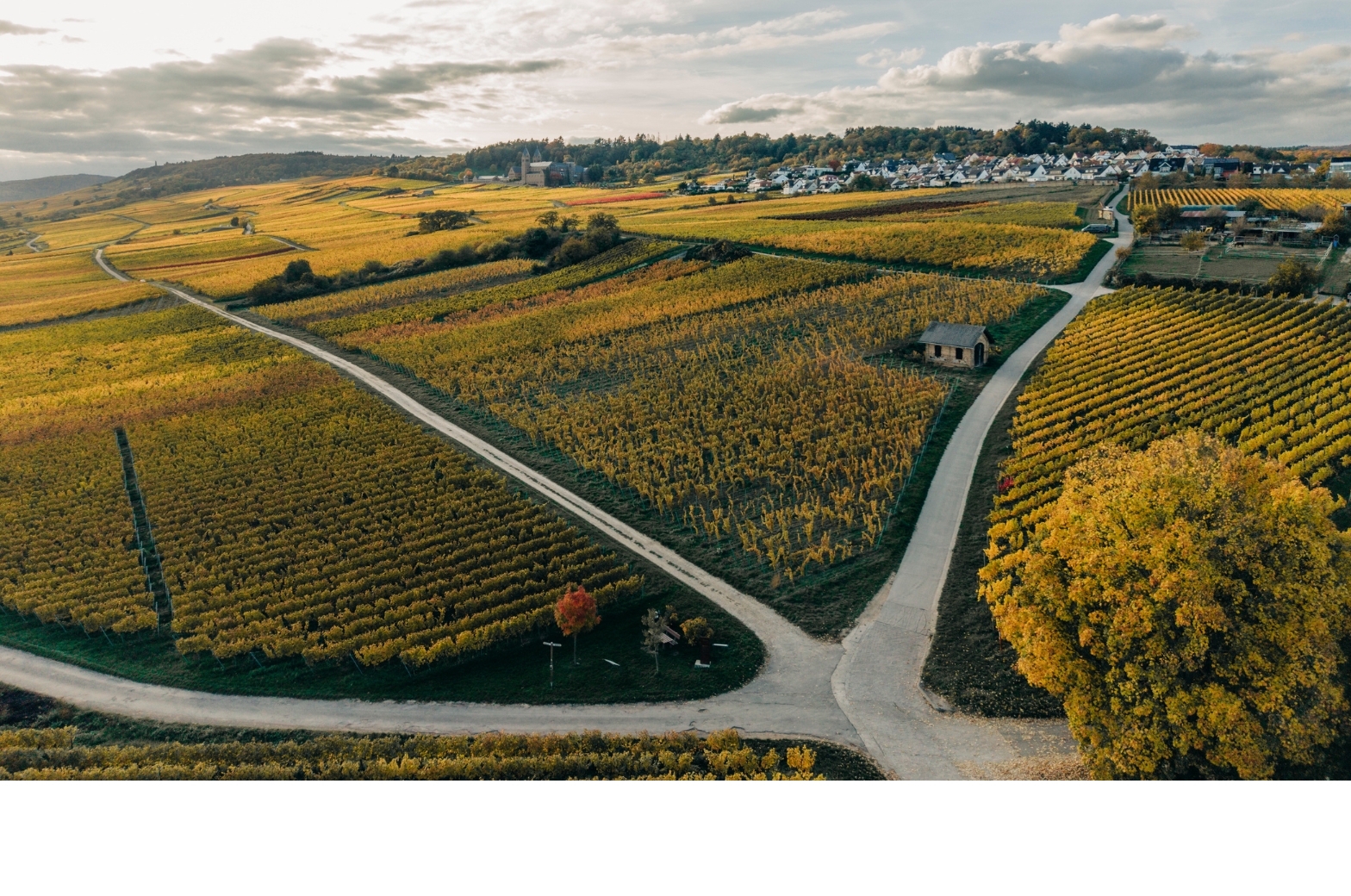
The south-facing site Rüdesheimer Magdalenenkreuz, which resembles a cloak draped along the left side of Rüdesheim in the landscape, was named after the numerous crosses erected in honor of Saint Mary Magdalene.
Far to the west, it lies close to the neighboring town of Geisenheim and offers views across the Rhine all the way to Bingen.
The gently rising slope with calcareous loess soil has a high groundwater level in its lower section, ensuring sufficient water supply even in very dry years.
As a result, powerful, persistent, and fruit-driven wines thrive here.

Rüdesheimer Kirchenpfad
The Kirchenpfad site once marked the path leading to the parish church of Rüdesheim’s district of Eibingen. The church is located in the eastern part of Rüdesheim, halfway up the hillside. Eibingen lies above Rüdesheim, and since its incorporation in 1935, the two communities have been seamlessly connected.
The vineyards are situated between St. Hildegard Abbey, the wine village of Eibingen, and the upper part of Rüdesheim. The Benedictine abbey, re-established in 1904 and enclosed within this site, gave the vineyard its name. The deep quartzite and loess soils, with their excellent moisture retention, provide outstanding conditions for vine growth.

Rüdesheimer Drachenstein
The name of this VDP.ERSTE LAGE® site originates from the discovery of a fossilized dinosaur footprint. In earlier times, this was believed to be proof that a dragon once lived in this vineyard. The area features sandstone and quartzite soils containing loess loam, derived from Taunus quartzite. In some parts, there are also very deep soils with considerable limestone content. As one of the highest-elevation sites in Rüdesheim, we clearly benefit from a cool microclimate here.
The wines are characterized by their floral and elegant style, complemented by a delicate spicy note. The dry wines from our vineyards in Rüdesheimer Drachenstein are highly refined and display an appealing minerality, shaped by the quartzite-influenced soils. The off-dry and sweet styles are exceptionally fruity—sometimes even exotic—and captivate with a beautifully balanced interplay of sweetness and acidity.

Rüdesheimer Bischofsberg
The VDP.ERSTE LAGE® “Rüdesheimer Bischofsberg,” located directly above Berg Rottland, features slopes ranging from 5 to 30%. It was presumably named after the Archbishops of Mainz, who permitted and promoted the clearing of the land for viticulture here.
Deep loess loam soils with slate inclusions and excellent water retention produce full-bodied wines with a distinctive acidity. In dry vintages, this site reveals its full potential among all Rüdesheim vineyards.
Our wines from Rüdesheimer Bischofsberg have excellent aging potential and become even more compelling with increasing maturity.

Rüdesheimer Klosterlay
The site takes its name from the Benedictine abbey of St. Hildegard, which was founded around 1100. The vineyards are situated around the monastery. In addition, the term “Lay” or “Lay-Fels” is historically associated with slate used for roofing.
The soil in this area consists of deep loess loam with excellent water retention capacity. The wines grown here are characterized by a fruity and spicy acidity as well as remarkable elegance.